Wednesday, February 29, 2012

What Price A Debt Unpaid?

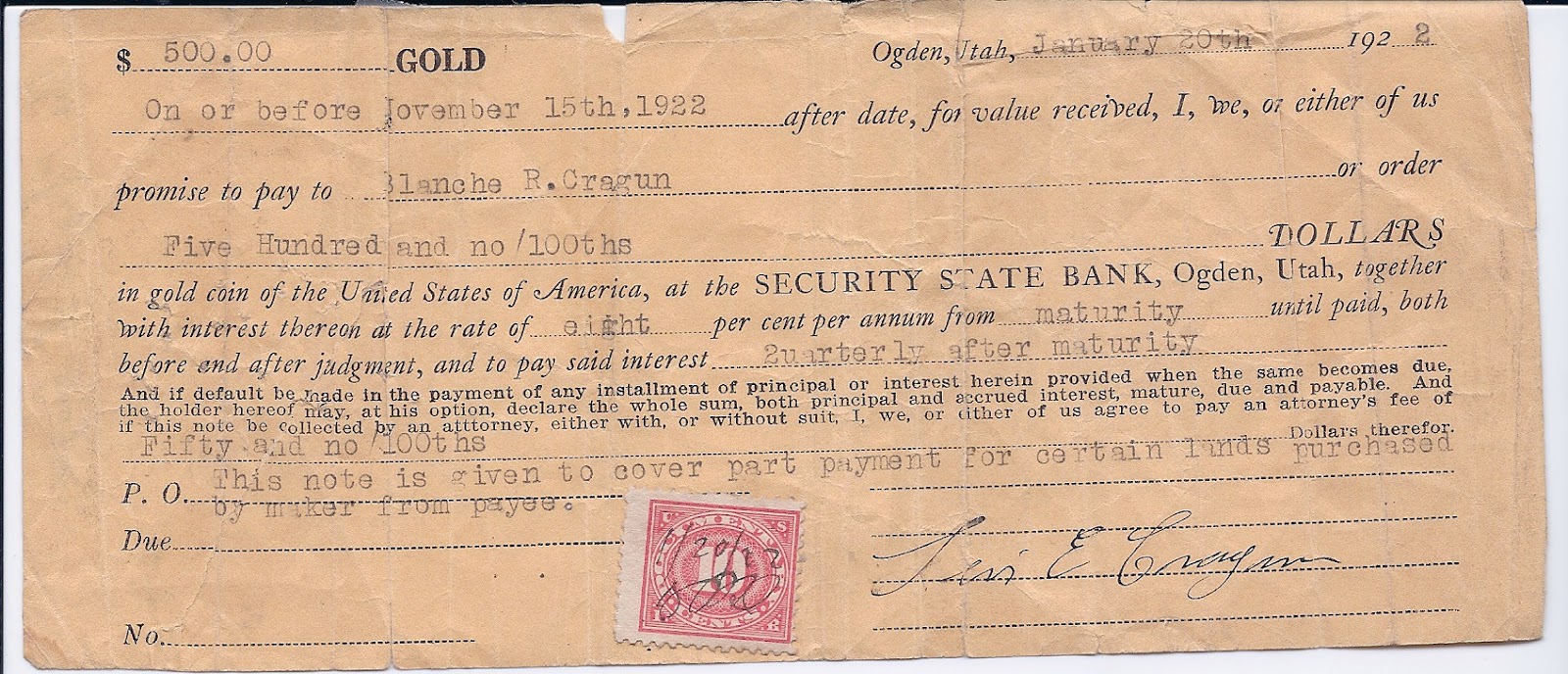
Promissory note from Levi Cragun

My father, Royal Cragun, passed this on to me. He told me this note was debt to be paid to my grandmother and grandfather by his son Levi as payment for the farm Levi took over.

My grandfather Simeon Wilbert Cragun became bitter and apparantly cut off all relationships with his son. 

I assume there were other issues, such as my grandmother being 28 and my grandfather 49 when they married. I sense that didn't go over very well.

So what price? A big one. Grandfather Simeon told my father, on grandfathers death bed, he was sorry he let it come between them.

So if by chance this bitterness has affected the Cragun legacy - let it be over with, OK?

Free & Easy Create Images of What's On Your Screen

Jing for Screenshots

Capture What You See -

Available to download at: www.techsmith.com/Jing

Jing is a free handy tool I have been using for years. It has inexpensive upgrades, for purposes like taking longer videos, but my main use is for taking a photo of something on my screen.
I believe that many of you that become active in FamilyTree will set up a blog, if for no other purpose than as a place to house your documents to link to from FamilyTree. You will like Jing!

An example of how you would use Jing, would be to take a photo of a document you find on line, and instead of having to copy the whole screen you copy just the document. You even  have the ability to make comments as you see in the example below.

The Jing sun sits nicely on your desktop, ready to capture all or any part of your screen at a moment’s notice. Jing will capture a window, pane, or region with just one click.

Cragun Family Home Pleasant View Utah

Or..... you might do what I just did in seconds: Jing a photo off the internet & post it on your blog for your children to see:

Shall we title it, big family big house?

Tuesday, February 28, 2012

At Home Missionary? - What Is That About?

The approximately 1000 family history missionaries that serve in Salt Lake City have a variety of assignments. Most are supporting questions and problems that patrons from around the world come up with in trying to do their own genealogy/family history.

That's not so with me, I'm assigned to a somewhat unknown part of the church - recruiting and processing at home missionaries.  There are about 500 that currently serve at home (At Home Missionaries). They go through 2 months of training, about 1.5 hours per day. They then become part of the system the full time support missionaries use to take the next phone call, email, or text. These are from what is usually a very frustrated or in need patron. They are not just church members.

We need about 1000 more to handle the growth of incoming questions. Here is a link to a video I hope gets the word out. It's a good one.

                           Click the link below the photo to go to the video

http://bcove.me/fz2jof1k


At home missionaries serve 15 hours per week and need a recommendation from their
bishop and Stake President. They need basic computer skills and adequate internet and computer standards. Their schedule is flexible. They are part of a team and have ongoing training with a full time church professional employee as their leader. Most at home missionaries serve supporting either new family search, indexing, research, the wiki, family history centers, or historical records.

Inquiries can be made by calling 1-800-453-3860 Ext 2-0850 or by email to mission@familysearch.org


Monday, February 27, 2012

Family Tree - Weighing The Best Documentation

The benefit of Family Tree will be a combination of the forums for discussion, the ability to link to a source, and the sharing of the documentation for analysis. Relatives can discuss the details of what is posted. One can look at mulitiple sources to determine which is the most reliable. New facts can be determined from a combination of sources.

For example: below is a copy of my cousins funeral program. If this were the only record it would be valuable in the decision making process. However, one would prefer official death and birth certificates.

Ray was in this database and the information it had was not documented, it was different in: Full name, birth place and date omitted, death date was different, and no place or date of buriel. All of these I was able to update based on the funeral program.

Another benefit, is that what I have here in this program may not be the best proof but may provide something factual a relative might want and it may be they are glad to be able to copy the program. If you only had this program there are some things it might be a clue to. Why was Howard Cragun conducting? Was he a Mormon Bishop? He was. We know where Ray was buried by this. Who knows what a program would mean to a descendant!

I also began watching Ray and his parents activity in Family Tree. This provides me an email when anyone makes a change, comment, or document to their file. Currently the email's come weekly, they hope to eventually make them immediate. This service connects you immediately to those who are working on that relative.

Pretty cool.

Raymond E Spalding Funeral Program

This brings up another point. Where do you place the document so you can link to it.  Family Tree won't let you upload the document, there will be millions of subscribers, and the service is going to be free. The server farms being built are already very expensive, can you imagine the costs to store everyones documents?

This is one of the reasons I started this blog. Every post has a unique link ID. For example, this one is: http://www.blogger.com/blogger.g?blogID=7507973415825745258#editor/target=post;postID=1726049901124148798

This link can be placed in family tree as access to the source. Doing it this way provides another benefit: my unknown cousins can find my blog and see my charming personality - and my vastly extensive knowledge about family, technology, and culture. :)

I would allow relatives to post documents on my blog, shall I say send them to me to post but don't let the concept be intimidating. As wildly technical as I might appear, starting and writing a blog is so easy anyone can do it. It takes so little time to setup and your 5th grader can do it. OK, your 1st grader then.


Saturday, February 25, 2012

Family Tree Update - Showing The Sources

Things are progressing fast with Family Tree features. So you want to see the source? OK, it's right here for your viewing.
Yes, you can now provide a link to see the sources. You just have to have a place like Flickr or a website to send peope to. That one is easy and can be free.

The fact that so many of us are related to each other makes this exciting. I have 2nd cousins whom I have never met or known of their whereabouts. Today I went in and added a link to a neat photo of their mother my 1st cousin. It is a terrific photo, she is beautiful. I am sure they will be overwhelmed when they check in, check sources, and find this of their mom.

I also added a link to this copy of my grandmother and my step grandfathers marriage license. It was easy and is now there for all of our relatives to see or download.

I really see the vision of collaberating via this free service, Family Tree.

Once again, Family Tree is in Beta with about 5,000 of us testing it. I can probably add you as a beta tester if you would like. Please leave me a comment or email at larry@cragun.net if you would like that.

Click here for a more in depth article I posted about Family Tree.

Friday, February 24, 2012

Getting Started - Family History Strategies - Part 2

Part 1 of this series is found by clicking here

I suggest you keep a log of the research you do. I have a separate section of a journal for each ancestor.

Below is what makes family history research a lot like detective work. There is excitement in this, just no danger. I suppose if you want danger you could take your laptop on a bungee jump or to the edge of a cliff.

However you do it, just go go go.


From a class taught at the Riverton Family History Center by: Diana Toland

One Thing (detail) Leads to Another (records).

Note occupations. Often found on the records, such as a census. They may be linked to a location or county records and perhaps in historical society news.

Military Records: draft cards are filled out by the individual in person, pension files require proof.

Immigration - generated passenger lists, border crossing cards often contain information about the relative.

Land and Probate. Probate records often have information such as family members and location.

Religious Records.  birth, marriage, cemetery, immigration, and histories are sometimes found this way.

Census: approximate ages confirmed, years married, parent information including locations of birth, and information on living children.

Obituaries: besides personal and family detail you sometime find out hobbies, successes, civic roles,and important information about relatives.


Wednesday, February 22, 2012

Access 29 Premium Pay Sites For Free At LDS Family History Centers

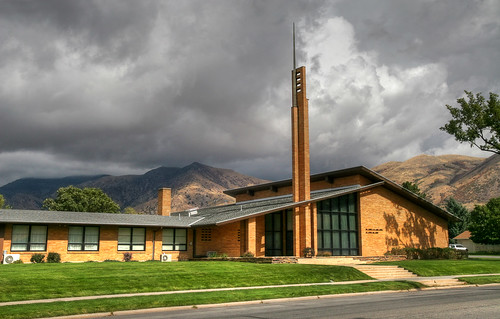
Brigham City Mormon Church

There are over 3700 English Speaking Family History Centers, so there is likely one near you. In addition to the other many free services, you can access numerous paid subscription sites using the church's Family History Center licenses.

Many of these centers are in or near a  Chapel such as the one above. They should be fairly easy to locate.

Here are most of the sites you can use:
  • Belfast and Dublin Ireland
  • 19th Century British Library of Newspapers
  • 19th Century U S Newspapers
  • American History and Life
  • Chronology of Irish in America
  • Ancestry.com World Wide addition
  • Famnet New Zealand
  • Find My Past
  • Fold 3
  • Genline - Swedish
  • Godfry Memorial library
  • History of Sligo County & Town (Ireland)
  • Heritage Quest Online
  • Historic Map Works
  • Historical Abstracts
  • Images of the American Civil War
  • J Stor - Schorlaly journals
  • New England Ancestors .org
  • Newspaper Archive.com
  • One Great Family
  • Oxford English Dictionary
  • Paper Trail
  • Pro Quest Obituary Listings
  • SVAR - Archives of Sweden
  • The American Civil War Research Database
  • The American Civil War - letters and diaries
  • The Genealogist
  • The Times - London
  • World Vital Records
Take this as my invitation to discover your local Family History Center

Don't Disinherit Your Children


Will, page 2

In researching my Cragun ancestors I came across some facts that brought home a sad memory. I found that one of my great grandmothers father disinherited her and her sister (John Amick). I find that she had joined the early Mormon church but her sister didn't. I have yet to find more detail on why.

My point in simple terms has nothing to do with the size of the inheritance, rather the insult it delivers. It's as if you the child didn't exist.

You were their parent. They did exist. That's it.

Here is a piece of the John Amick story (and other Amicks) by Jerry Mower a 3rd Great Grandson and a link to his Amick website.


I, John Amick of Monroe township being of sound mind and memory thanks be to God, do make and publish this my last will and testament hereby revoking and making void all former wills by me at any time heretofore made and First I direct that my body be decently interred in the burying ground of the Clear Ridge Meeting House in the said township according to the rules and ceremonies of the said Church and that my funeral be conducted in a manner corresponding with my estate and situation in life. And as to such worldly estate as it hath pleased God to entrust me with I dispose of the same as follows: .......... It is my will that my son John Amick and John Martin Esq. Exec of this my last will and testament. Signed 21 day of May 1843. John Amick his mark X
We can learn some interesting things about the make up of John Amick's family as it stood on 21 May 1843. We know through this will that daughter Mary, who had just joined the Mormon Church was basically disinherited. Why Susannah was disinherited I do not know as she did not join with the Mormons.

Tuesday, February 21, 2012

Elisha Cragun Story


<>
Virginia
Virginia


Elisha is believed to have been born at either Russell County, VA or Sullivan County, TN on February 22, 1786, the second child of Patrick and Rose Alley Cragun. While Elisha's birthplace may have been in doubt, his Virginia connection was certain through his wife.
 
In 1811 he married Mary (Polly) Osborn, daughter of James and Mary (Whitaker) Osborn of Castle's Wood, then in Washington County, Virginia (now Castlewood in Russell County, Virginia). The Osborn's are recorded as being wealthy slave and land owners of the area.
 
Polly's father, James Osborn(e), was a member of the second group of settlers to reach the Castlewood area of Russell County Virginia shortly after 1769. It was a part of the Clinch River settlements in extreme southwest Virginia. His father, Caleb, was owner of a plantation of over 579 acres in the area of Cedar and Dutchman's Creek at the Forks of the Yadkin, Rowan County, North Carolina. James' wife, Mary Whittaker, was (probably) the daughter of one of the Whittakers whose land adjoined that of the Osborn's.

James Osborn was listed as a soldier at Moore's Fort in 1777. It was located at Cassell's Woods and until 1775 had been under the command of Daniel Boone who at that time departed the area to make his second entry into Kentucky. The story of Moore's Fort and the names of its' soldiers on June 30, 1777 can be found in the Historical Sketches of Southwest Virginia, Pub#4, 1986, of the Historical Society of Southwest Virginia. James died on Dec 14, 1821 leaving to his widow the dwelling house, 1/3 of that tract of land and two Negroes. The remainder of his farm and eight Negroes were left to his son, Solomon. His other children, including Polly Cragun, Elisha's wife, were each bequeathed a certain undisclosed sum of money.

Polly was born in 1790, the youngest of nine children. Married at age 21, when Elisha was 25, they moved the fifty miles or so to join Patrick and the family in Sullivan County, Tennessee, where Rebecca was born to Mary in 1812 after Elisha had departed for army service.

Polly's older brother, Jonathan, migrated along with members of the Alley family to the area that became Franklin County, IN in 1811, the same year that the land was opened for settlement having been obtained from the Indians in 1809 by the Twelve Mile Purchase treaty. In 1813 he was among the first to draw land. The next year, in 1814, Elisha and Polly left Sullivan County, TN with their daughter, Rebecca, and on September 16th. entered four surveys of land near Jonathan's property and adjoining property of Peter Alley along Pipe Creek, at the junction of Metamora and Butler Townships in Franklin County, IN. Apparently, Elisha's entry into Indiana was delayed by service in the war of 1812 in which his brothers Isaac and John also served. Both John and Elisha are said to have served with the troops of General Andrew Jackson; however, Elisha's service can not be verified through records at the National Archives.

Later, on March 2, 1819, Elisha's younger brother, Caleb, twin of Joshua, entered a survey in the same area in Franklin County as Elisha and married the widowed Sarah (Alley) Jones with two children. By 1828, Joshua Cragun also settled in Franklin County; however, sometime between 1825 and 1827, Elisha and Polly moved on to Noble Township near Richland in Rush County after that land was opened for settlement following the St. Mary's Treaty with the Indians.

One can only be impressed with the way Elisha and his family kept following the frontier. As new lands were opened for settlement, they moved into them and developed farms bringing civilization along with them. They settled land and cultivated it in contrast to speculators of the time who claimed and simply held land against the hope of increased prices thus retarding both settlement and development of the frontier as it moved west.
With the exception of Rebecca, who had married and established her own home with Aaron Beeman in Rush County, in 1835 Elisha, Mary, and their nine other children claimed land in Boone County, cleared it of growth including the black walnut trees which grew in abundance and began to farm near what became known as the Pleasant View Community in Eagle Township between Zionsville and Whitestown. Not much is known about the family during this period. The record indicates that Mary died December 14,1844 at age 54 and daughter Abigail died three days later on December 17 at age 21. They were buried side by side on the farm in an otherwise unmarked grave where a large black walnut tree then stood.

Heiner described the land in 1965 as being lush and green with a stream called Jackson's Run flowing through the Pleasant View Church yard. This is now the location of Hutton Memorial Cemetery East of Whitestown where several family members have been buried. Heiner also reports that Elisha sold all or part of his holding to Washington St. Clair on September 8, 1845. This perhaps marks the breakup of the homestead done in preparation for the next shift to the west, which is explained by Heiner as follows: "During their moves from one county to another, Elisha encountered two Mormon missionaries - Nathan T. Porter, and Wilber Earl. Their doctrine appealed to Elisha and his wife, Mary. A very good friend, Henry Mower, a Methodist minister, had been converted to the Latter-day Church of Jesus Christ and he also influenced their faith and baptized Elisha 15 March 1843 at Jackson's Run."

After the death of his wife and daughter and sale of his property, Elisha made his way to Nauvoo, Illinois, to be near the head of the church there receiving a Patriarchal Blessing on November 10, 1845. Heiner also reports that Elisha was accompanied by several members of his family. With him at Nauvoo were his sister, Elizabeth, and brother, Syren. The record also shows that all of his surviving children except Hiram departed for the west. Two sons, James and Simeon and three daughters: Mary, Tyresha, and Tabitha ultimately completed the treck and settled in Utah. Rebecca Cragun Beeman and her family were reported by her son, Elisha, living in 1909 near Elizaville, Indiana, to have gone as far as Council Bluffs, Iowa, and then turned back for unknown reasons.
Elisha Cragun's fifth child, Enoch, and his wife, Molly (Peters), got as far west as Missouri then went north to Minnesota establishing a branch of the family which still lives in the area of Brainard, Minnesota.

Sara Jane, Elisha's youngest child, is reported to have died in 1847 or 1848. Nothing further is known of her.
Elisha is believed to have departed with a party from Nauvoo headed for Utah and got as far as Council Bluffs, Iowa or Winter Quarters, Nebraska where he died during the winter of 1846-47 at age 61. No record of his grave has been found, but he may be burried in one of the nearly 800 unmarked graves at the cemetery near the encampment at Florence, Nebraska on Rt.#75, north of Omaha, a victim of a cholera epidemic that winter.
Monday, February 20, 2012

Family History - Getting Started Strategies

C5  Track Meet DWP_0061


Get Ready

Get Set

GO GO GO


The Riverton Family History Center in the Salt Lake City area is a shining example of what the LDS Family History Centers are to become: not only a place of research & support but a place of learning. 


This photo depicts what it was like Saturday at the monthly training.
There was an hour long keynote speaker and then 2 hours of classes, several to choose from.


The Riverton Family History Center is larger than your local center, but the concept will be the same. At this time you can find help, a computer to use, and individual attention at a local Family History Center.


The class I attended was on research strategies by Diana Toland: and it was excellent. I will share with you in a series of articles that are strategies I gleaned from Diana.

Build on what you already know: Review all of your notes, files, documents, letters, clippings, or informaiton about your ancestors.  Look for clues from these records.

My sister  is an excellent genealogist. Besides realizing she is doing something of great value to a great cause she loves being a detective looking for clues and facts. That is what you will be doing.

a. Review all the notes, files, documetns letters, clippings, or information about your ancestors. 

b. Call of visit any living relatives that might have any information, memories, or keepsakes about your family.

If you watch the national TV show "Who Do You Think You Are" or the BYU TV show Generations Project you will see that in action.

c. Should anuy relative pass away, IMMEDIATELY contact the executor of the estate. Check on dispostion of the "Family Records" and vital documents.

Getting copies of all vital records is a valuable exercise.  I phoned my mothers sister for inromation on my grandmother. Her immediate response was I was only 4 when my mother died, I have nothing to help you with about her. We went and visited her anyway. Guess what, she did find a file with a few things of importance. Oh, how important they were. She also remembered a few things she was told. What a productive visit it was.

d. Check to see who else is working on your family online. That can be done by joining New Family Search, soon to become Family Tree, Ancestry.com, Roots Web Worldwide, and by doing Google searches just as an example.

I'd be glad to give you feedack on this topic if you have questions.

I plan on making this series at least 7 articles. I hope it helps.